Coastal Resilience & Erosion
Coastal erosion isn't uniform. Some shorelines retreat measurably faster than others, depending on sediment type, wave exposure, and whether nearby hard armoring has disrupted the natural flow of sand along the coast. The response to that erosion has become a genuine engineering debate: hard structures like seawalls stop erosion at one point but can worsen it next door, while nature-based "living shoreline" approaches trade some storm resilience for habitat value and lower long-term cost.
These guides walk through both the causes of coastal erosion and the real trade-offs between hard and nature-based adaptation, so a coastal property owner or planner can weigh the actual evidence rather than a marketing pitch for either approach.
Coastal Resilience & Erosion guides
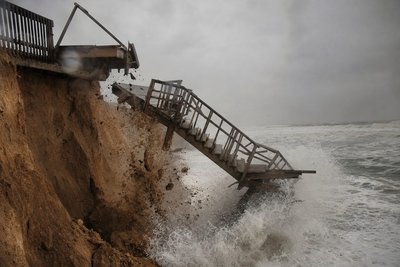
Sand along most coastlines moves in a continuous system called littoral drift: waves and currents carry sediment along the shore, replenishing beaches downdrift as fast as erosion removes it elsewhere. Hard structures like seawalls and groynes interrupt that flow: a seawall protects the property behind it but can accelerate erosion on the beach in front of it and on neighbouring, unprotected shorelines further along the drift path, a well-documented effect known as end-effect or downdrift erosion.
Living shorelines, using planted marsh grass, oyster reefs, or graded and vegetated banks instead of a hard wall, work with that sediment system rather than blocking it, absorbing wave energy while still allowing sand to move. They generally cost less to install and maintain than hard armoring over the long term and add habitat value, but they are not a universal substitute: high-energy coastlines with intense wave exposure may still need some hard structural element, and the right approach depends heavily on local wave climate, sediment supply, and how much land is available to work with.
Choosing between the two is ultimately a site-specific engineering decision rather than a one-size-fits-all rule, which is why a growing number of coastal authorities now require a shoreline assessment (covering wave exposure, sediment supply, and adjacent-property impact) before approving either a hard structure or a living-shoreline project.
Frequently Asked Questions
Do seawalls actually make erosion worse nearby?
+
They can. A seawall protects the property directly behind it but reflects wave energy and can starve the beach in front of it and neighbouring shorelines of sediment, a documented effect often called end-effect or downdrift erosion. It's one of the main reasons planners increasingly weigh living-shoreline alternatives.
What is a living shoreline?
+
A living shoreline is a coastal-erosion defense built from natural or nature-based materials, including planted marsh vegetation, oyster or shellfish reefs, and graded and stabilized banks, rather than a solid engineered structure like a seawall or bulkhead. It absorbs wave energy while allowing natural sediment movement to continue.
Are living shorelines as effective as seawalls in a major storm?
+
It depends on wave exposure. On lower-energy shorelines, well-designed living shorelines can perform comparably to hard structures while adding habitat value and lower maintenance cost. On high-energy, storm-exposed coastlines, a hybrid approach combining some hard structural element with nature-based components is often more appropriate than either extreme alone.
Why does one property erode faster than its neighbour?
+
Erosion rate is driven by a combination of factors specific to each stretch of coast: sediment type (sand versus clay or rock), wave and storm exposure, local currents, and whether nearby hard structures have disrupted the natural sediment supply reaching that shoreline. Two properties a short distance apart can experience meaningfully different erosion rates for exactly this reason.