Stand on an asphalt parking lot in July, then walk thirty feet into a nearby park. The difference is obvious before anyone checks a thermometer. That gap has a name: the urban heat island effect, and it is the reason cities routinely run hotter than the farmland, forest, or scrubland surrounding them. It is not a new phenomenon. A London chemist named Luke Howard documented the city running warmer than its countryside as far back as the 1810s, in a book called “The Climate of London,” decades before anyone had a word for it. What’s changed is scale. More people live in cities now than at any point in history, and those cities keep adding the exact materials that make the problem worse.
The mechanism itself is not complicated. What’s harder is doing anything about it once a downtown core is already built out of asphalt, glass, and dark roofing.
Why Asphalt and Concrete Hold Onto Heat
Sunlight lands on every surface the same way, but materials handle that energy very differently. A grass field reflects some solar radiation and spends a meaningful share of the rest evaporating moisture from soil and leaves, a process that cools the surface much the way sweat cools skin. Dark asphalt and dark roofing do almost the opposite. They absorb most of the incoming sunlight, convert it directly to heat, and hold onto that heat because they are dense, dry, and full of thermal mass.
Materials scientists describe this with a property called albedo, the fraction of light a surface reflects back rather than absorbs. Fresh snow has an albedo near 0.8 or 0.9. New asphalt sits closer to 0.05, meaning it absorbs nearly everything that lands on it. Concrete falls somewhere in between depending on its age, its color, and how much it’s weathered, which is one reason cool-pavement coatings usually target lighter aggregate mixes rather than trying to replace asphalt outright across an entire road network. Glass and metal-clad buildings add a separate wrinkle: some of that energy doesn’t just get absorbed, it gets reflected sideways into neighboring streets and windows, warming spaces that never received direct sun at all.
Why Nights Don’t Cool Down
Daytime heat gain is only half the story. The other half happens after sunset, and this is where the urban heat island effect becomes most noticeable to the people actually living inside it. Rural land loses its stored heat quickly once the sun goes down, because vegetation and open soil radiate that energy back to the open sky with little in the way. Dense cities do the opposite on almost every count. Tall buildings narrow the visible slice of sky at street level, which traps outgoing infrared radiation the way a partial ceiling would. Thermal mass in concrete, brick, and asphalt releases stored warmth slowly, over many hours, instead of shedding it all at once the way a thin layer of topsoil does. Add waste heat pouring out of air conditioning units, vehicle engines, and machinery running well into the evening, and a downtown block can stay noticeably warmer than a park two miles away long past midnight. Some cities don’t drop below their daytime peak by more than a couple of degrees all night.
How Much Hotter, Exactly
Numbers here vary by city, season, and how the measurement is taken, so treat any single figure as a rough guide rather than a hard rule. The US Environmental Protection Agency, which runs a long-standing Heat Island Effect program, cites a general range of 1 to 7 degrees Fahrenheit warmer during the day for urban areas compared with surrounding rural land, and up to 5 degrees warmer at night. That nighttime figure tends to matter more for public health outcomes, since the overnight cooling window is what gives people, and buildings, a real chance to recover from a hot day before the next one starts.
Researchers have also turned to satellite thermal imagery to get a fuller picture than ground sensors alone can provide. NASA and NOAA both operate programs that map land surface temperature from orbit, layering that data over city grids to see exactly where the heat concentrates. Those maps consistently show the same pattern regardless of which city gets studied: temperature tracks pavement and rooftop density block by block, and parks, tree-lined streets, and waterways show up as distinct cool patches even in the middle of the hottest neighborhoods. It’s a strikingly consistent signature once you know what to look for.
The Cooling Strategies Cities Are Actually Testing
None of the fixes here are exotic. Most of them are decades old as ideas. What’s changed is that more cities are funding them at real scale instead of running them as one-off pilot projects that quietly end when the grant money does.
Reflective Roofs and Cool Pavement
Cool roofing uses lighter-colored or specially formulated reflective materials in place of standard dark roofing, cutting how much heat a building’s own roof absorbs in the first place. It’s inexpensive relative to almost any other retrofit, it’s well-proven, and a growing number of building codes in warm US states now require or financially incentivize it on new commercial construction.
Cool pavement applies the same logic to streets instead of roofs. Los Angeles has run a cool-pavement pilot through its street services agency, coating select residential streets with a lighter, specially formulated sealant and measuring surface temperature before and after. The results have shown real, repeatable drops in surface temperature on the treated pavement itself. The catch, worth stating plainly, is that cooler pavement doesn’t automatically mean cooler air a few feet above it. Reflected sunlight still has to go somewhere, and on a narrow street lined with tall buildings, some of that reflected energy bounces right back at the people walking on it.
Trees, Shade, and Green Infrastructure
Tree canopy does more per square foot of city than almost any other single intervention, because it combines direct shade with evaporative cooling from leaves, the same mechanism that keeps a forest floor noticeably cooler than an open field on the same afternoon. Phoenix, which established the country’s first Office of Heat Response and Mitigation in 2021 specifically to coordinate this kind of work across departments, has made canopy expansion a formal citywide target rather than a discretionary landscaping line item. Green and “blue” infrastructure, including vegetated medians, bioswales, and restored urban waterways, extends the same principle across a larger area, though it takes years for newly planted trees to grow large enough to actually shift a neighborhood’s microclimate. Patience is not a strong selling point in a budget cycle, and that mismatch is part of why canopy programs are harder to fund than a one-time pavement coating.
Not Every Neighborhood Bakes Equally
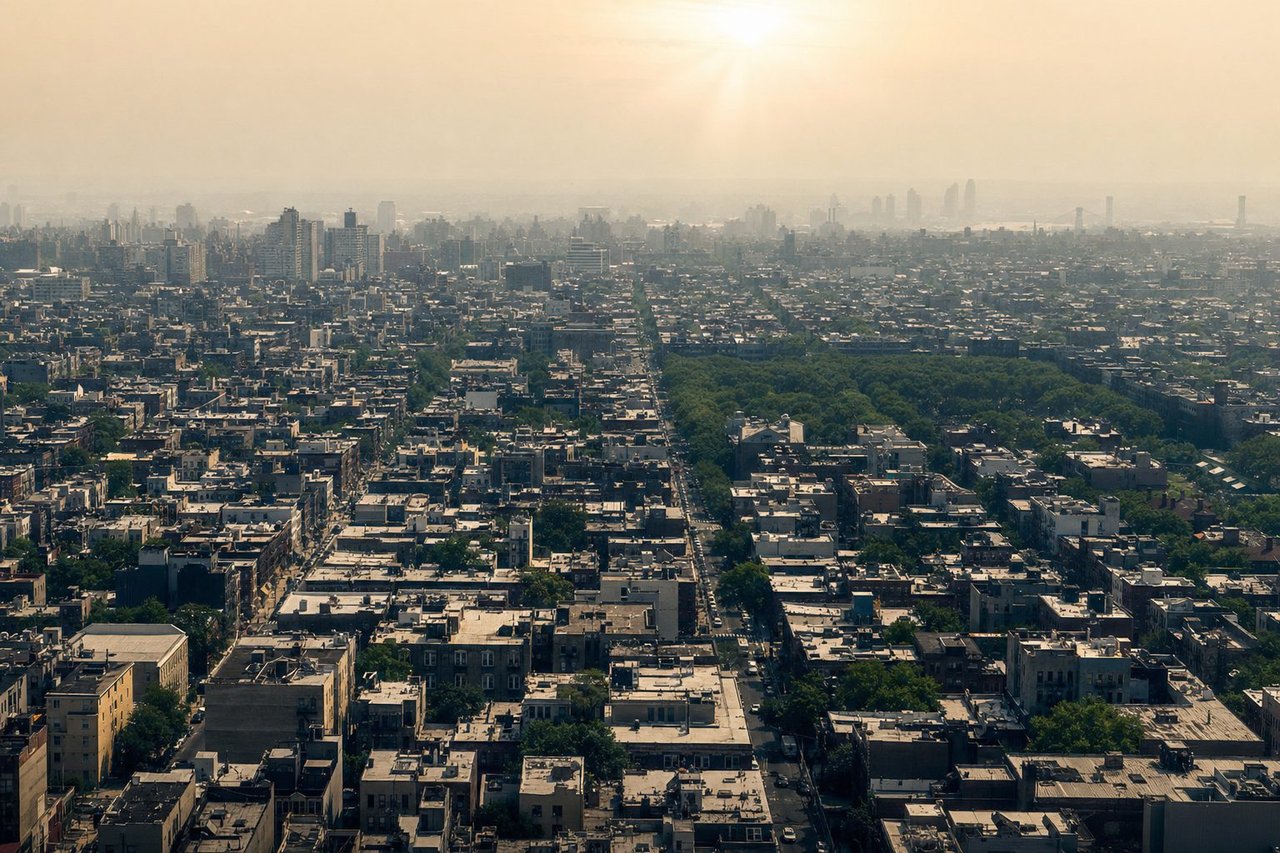
This is the part of the story that doesn’t get enough attention. Within a single city, heat exposure is not evenly distributed, not even close. Neighborhoods with less tree canopy, more paved surface, older building stock, and fewer parks consistently measure several degrees hotter than greener, higher-income neighborhoods only a few miles away in the same city. In a number of US cities, researchers have found that this gap tracks closely with historical redlining boundaries drawn by federal mapmakers nearly a century ago. That correlation is not a coincidence of weather patterns. It’s the direct, traceable legacy of decades of decisions about where park investment, street trees, and building upgrades did and did not happen.
The practical result is uncomfortable but straightforward: the households least able to afford air conditioning often live in the exact parts of a city running the hottest, both day and night. Seen at block level, that gap is the urban heat island effect doing its work unevenly rather than uniformly. Any heat-mitigation plan that reports a single citywide average temperature and calls the problem addressed is missing the point entirely.
The unevenness is the problem, arguably more than the average itself.
What Individual Property Owners Can Actually Influence
You cannot fix a city’s heat island effect from your own backyard. But you can measurably change the microclimate right around your own building, and that adds up once a whole street does it together.
- A light-colored or reflective roof coating, applied at replacement time, cuts how much heat a roof absorbs and lowers indoor cooling costs through the summer.
- Shade trees planted on the south and west sides of a property intercept afternoon sun before it ever reaches a wall or window.
- Swapping a section of paved driveway or patio for grass, gravel, or permeable pavers reduces how much surface is available to store and re-radiate heat after dark.
- Light-colored exterior paint and simple awnings do a smaller version of the same job as a cool roof, at a fraction of the material cost.
None of this is dramatic on its own. A single reflective roof will not move the reading at the nearest weather station. But a street full of them, paired with real tree cover instead of a few ornamental shrubs by the entrance, starts to resemble the kind of block that shows up as a cool patch on a NASA thermal survey rather than a hot one. No city has yet worked out how to get an entire aging housing stock to make that switch at once, and that gap between a proven fix and a slow rollout is where most of this story currently sits.
Frequently Asked Questions
What is the urban heat island effect?
+
It's the tendency of cities to run warmer than the rural or vegetated land around them, because pavement, roofing and building materials absorb solar energy that grass and tree canopy would otherwise reflect or use for evaporation. The effect is strongest in dense downtown cores and weakest at the leafy edges of a metro area.
How much hotter are cities than surrounding rural areas?
+
The US EPA cites a general range of 1 to 7 degrees Fahrenheit warmer during the day and up to 5 degrees warmer at night, though the exact gap depends on a city's size, density and vegetation cover. Nighttime is usually where the difference is most noticeable, because rural areas cool off quickly after sunset and dense urban cores don't.
Why do cities stay hot after the sun goes down?
+
Concrete, brick and asphalt release the heat they absorbed during the day slowly, over many hours, instead of all at once. Tall buildings also trap warm air at street level and block the sky, which reduces how much heat can radiate away into the night.
What is cool pavement and does it actually work?
+
Cool pavement is a lighter-colored coating applied over standard asphalt to reflect more sunlight instead of absorbing it. Field pilots, including one run by the city of Los Angeles, have measured meaningfully lower surface temperatures on treated streets, though the effect is limited to the pavement itself and doesn't do much for air temperature a few feet above it.
Cool roofs vs green roofs: which cools a building more effectively?
+
Cool roofs (light-colored or reflective coatings) are cheaper and reduce a building's own cooling load quickly. Green roofs, planted with vegetation, do more for the surrounding air through evaporation and shading, but cost far more to install and maintain, and not every roof structure can support the added weight.
How much does a cool roof coating cost compared to a standard roof?
+
A reflective coating typically adds a modest premium over standard roofing material, though the exact figure varies by region, contractor and roof size. Many building owners recover part of that cost through lower summer cooling bills within a few years, which is why several US cities now offer rebates for it.
Is the urban heat island effect dangerous to health?
+
Yes, particularly for older adults, infants, outdoor workers and people without reliable air conditioning. Because the heat island effect keeps nighttime temperatures elevated, it removes the overnight cooling window that bodies normally use to recover from a hot day, which is a major factor in heat-related illness during prolonged heat waves.
Which neighborhoods are hit hardest by urban heat?
+
Formerly redlined and lower-income neighborhoods tend to have less tree canopy, more paved surface and older, less reflective building stock, and multiple US studies have measured them running several degrees hotter than wealthier, greener neighborhoods in the same city. It's a well-documented equity gap, not a marginal one.
What can a homeowner actually do about the urban heat island effect?
+
Planting shade trees near south- and west-facing walls, choosing a lighter roof material at replacement time, and reducing paved surface in favor of grass or permeable pavers all help at the scale of a single property. None of it will cool the whole city, but it measurably lowers the temperature right around that building.
Do any cities have a dedicated office for heat?
+
Phoenix created the Office of Heat Response and Mitigation in 2021, the first of its kind in the United States, to coordinate cooling centers, tree planting and pavement programs under one roof. A handful of other cities have since set up similar heat-officer roles.
Is the urban heat island effect the same thing as a heat wave?
+
No. A heat wave is a regional weather event that affects cities and countryside alike. The urban heat island effect is a separate, local layer on top of that: it's the reason a city's downtown often stays several degrees hotter than a field twenty miles away during the exact same heat wave.
Does painting a roof white really make a measurable difference?
+
Yes, at the building level. A white or reflective coating can lower a roof's surface temperature by a wide margin on a sunny afternoon, which cuts down how much heat migrates into the building below. It won't change the temperature at the nearest weather station, but it changes the temperature inside that specific building and the air right above that specific roof.