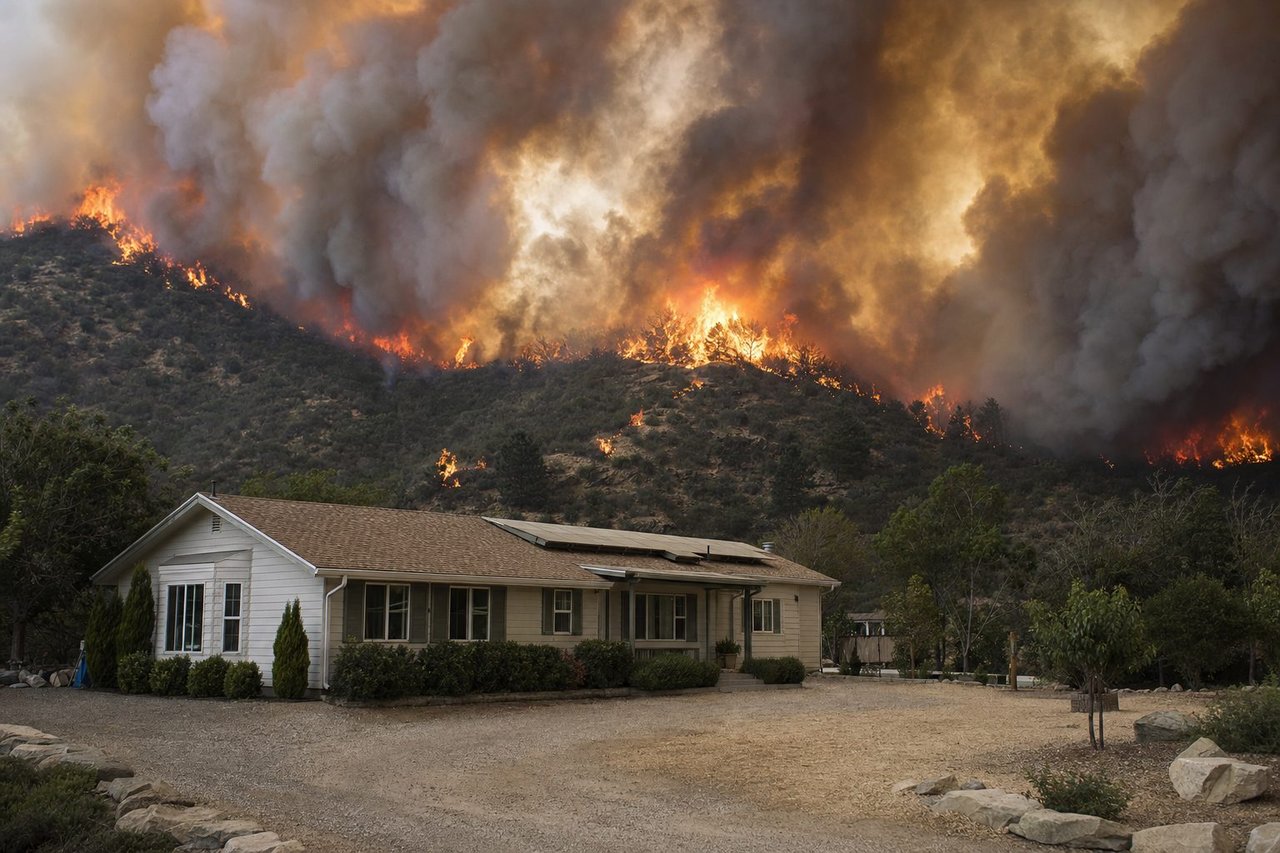
Wildfire preparedness used to mean something simpler a generation ago: keep a hose within reach, rake the leaves in fall, hope for rain. That framing doesn’t hold up well anymore across much of the wildland-urban interface, where subdivisions now sit inside terrain that used to burn on its own cycle with nobody close enough to notice or care. What changed isn’t just the fire. It’s how many homes now sit where fire is a recurring visitor rather than a rare event, and how little the standard homeowner playbook has adjusted to match.
There’s a useful correction buried in that shift, though. A house is not a passive victim in a wildfire. Investigations by agencies like CAL FIRE, along with building-science research from the Insurance Institute for Business & Home Safety (IBHS), have shown again and again that most homes lost in a wildfire don’t burn because a wall of flame rolled directly over them. They ignite from embers: small, wind-carried sparks that settle in a gutter full of pine needles, slip through an unscreened vent, or catch on a woodpile stacked against the siding. That single finding reframes most of what preparedness actually requires: distance and materials, not heroics, decide the outcome in the majority of cases.
What Defensible Space Actually Means
Defensible space is the managed buffer between a structure and the vegetation, fencing, and stored materials that could otherwise carry fire toward it. CAL FIRE and Firewise USA (the National Fire Protection Association’s homeowner recognition program) both teach it as a zone system, and although the exact footage shifts by state and local ordinance, the underlying logic stays consistent wherever it’s taught.
Zone 0: the immediate zone (0 to 5 feet)
This ring right against the walls is the one fire scientists increasingly treat as non-negotiable. It should be essentially free of anything combustible: no bark mulch pressed against the foundation, no stacked firewood, no dry ornamental grasses under a window. Roof and gutter debris counts here too, since it sits directly against the structure even if it technically fell from above. Some newer state-level codes now specifically call this a “zero zone,” which tells you how much weight fire agencies now put on it.
Zone 1: the intermediate zone (5 to 30 feet)
Here the goal shifts from elimination to spacing and maintenance. Trees are kept limbed so the lowest branches sit well above ground-level fuels, a practice fire crews call removing the “ladder fuel” that lets a small ground fire climb into a tree canopy. Lawns stay mowed, shrubs stay pruned apart from each other rather than forming a continuous hedge line, and any structures like sheds or fences get treated as extensions of the house rather than separate concerns. This is also where defensible-space guidance runs headlong into whatever mature shade tree or privacy hedge someone spent a decade growing next to the patio, and the guidance rarely bends to accommodate it.
Zone 2: the extended zone (30 to 100 feet and beyond)
On flat, low-vegetation lots this zone can be modest. On a forested hillside lot it becomes the most important one, because slope and wind both accelerate fire behavior dramatically compared to flat ground. Thinning tree density, removing dead and downed material, and breaking up continuous brush cover here reduce the intensity of a fire long before it ever reaches the house.
Home-Hardening Materials That Actually Change Outcomes
Defensible space buys time and reduces exposure. Home-hardening decides what happens to the structure itself once embers arrive anyway, which they usually do regardless of how well the yard is managed.
Roofing and gutters
Roof material and rating matter more than almost any other single retrofit. A Class A fire rating is the target, and plenty of asphalt shingle products carry it — this isn’t only a metal-roof or tile-roof decision, contrary to what a lot of homeowners assume. Untreated wood shake and shingle roofs carry the weakest ratings and are consistently the ones fire agencies push hardest to replace. Gutters matter almost as much: a gutter packed with dry leaves sitting right at the roofline is functionally a fuse, and guards that keep debris out are a low-cost fix relative to the roof itself.
Vents, eaves, and attic openings
Post-fire investigations keep turning up the same pattern: embers entering through unscreened attic, crawlspace, and foundation vents, often before any visible flame reaches the property. Swapping standard vent screens for 1/8-inch metal mesh, or installing purpose-built ember-resistant vents, closes that gap for a few hundred dollars per vent in most retrofit jobs. Enclosed eaves, rather than open rafter tails that expose the underside of the roof structure, reduce a second common entry point.
Decking, siding, and window glazing
Wood decking attached directly to a house functions as a wick if it ignites, so ignition-resistant composite decking or non-combustible materials near the structure make a measurable difference. Siding matters less in isolation than most homeowners think, but the gap where siding meets the ground, often hiding a nest of dry leaves, deserves the same attention as Zone 0. Dual-pane windows with at least one tempered pane resist the radiant heat that shatters ordinary single-pane glass and lets embers and heat straight into a house.
How Wildfire Risk at the Wildland-Urban Interface Is Changing
Two trends are compounding each other. Fire seasons in many fire-prone regions now start earlier and run later than they did decades ago, driven by earlier snowmelt, drier summers, and longer stretches without meaningful rain, a well-documented shift even without pinning it to a single exact figure. At the same time, housing growth has pushed steadily into terrain that used to be sparsely populated forest or brushland, simply because that’s often where available and affordable land sits near growing metro areas.
Put those two together and the wildland-urban interface (the zone where houses and wildland fuel actually meet) has both grown in size and become harder to protect uniformly, since it now spans an enormous range of terrain, vegetation, and construction eras. Older homes built before modern building codes existed sit next to recently built, better-hardened ones on the same street, which is part of why fire investigators sometimes see wildly different outcomes on adjacent lots after the same fire passes through.
Insurers have noticed.
A number of carriers in the most fire-exposed markets have pulled back availability or raised rates sharply enough that state-run insurers of last resort have picked up a growing share of policies in some regions. Programs like the IBHS Wildfire Prepared Home designation exist partly as a response: a standardized way for insurers to recognize documented mitigation work rather than pricing every property in a fire-prone zip code identically.
A Practical Action Plan for This Season
Most of this work doesn’t require a contractor. It requires a weekend, a ladder, and the discipline to actually finish the walk around your property rather than starting at the front yard and losing momentum by the back fence.
Core defensible-space checklist
Do the immediate zone first. It’s the smallest area, it has the largest effect on ignition risk, and it’s the one most homeowners let slide because it’s also the area closest to windows, patios, and the parts of the yard people actually use. Zone 1 and Zone 2 work can spread across a full season without much loss of protection, since the intermediate and extended zones mainly buy time and reduce fire intensity rather than directly determining whether embers reach the walls.
The Community Side: Ordinances, CWPPs, and Insurance
None of this happens in isolation. A growing number of fire-prone counties and municipalities have adopted mandatory defensible-space ordinances, sometimes enforced through inspections triggered by a home sale, a permit application, or an insurance renewal rather than routine patrol. Community Wildfire Protection Plans, developed jointly by local fire departments, government, and residents, identify high-risk zones across an entire community and prioritize fuel-reduction projects at a scale no individual homeowner could tackle: a shared fuel break along a ridgeline, say, or coordinated thinning across dozens of adjoining private lots.
Firewise USA sits in a similar space, giving whole neighborhoods a shared framework and, in some markets, a credential that carriers factor into underwriting. None of it removes the tension at the center of wildfire preparedness, though: a homeowner can do everything right and still be exposed if the neighboring property, thirty feet away, is stacked with untended brush. That’s less a flaw in any single program than a reminder that in the wildland-urban interface, the property line was never actually where the risk stopped.
Frequently Asked Questions
What is wildfire preparedness, exactly?
+
It's the combination of defensible space around a structure, fire-resistant building materials, and a household evacuation plan that together reduce the odds a home ignites and the odds people are caught off guard when they need to leave. It isn't one action; it's the layering of several that matters.
How wide should defensible space be around my house?
+
Most programs, including CAL FIRE's, use a zone system running out to 100 feet or more where terrain allows: an immediate zone within 5 feet of the structure, an intermediate zone out to about 30 feet, and an extended zone beyond that. Slope, wind exposure, and local ordinance can push the recommended distance further.
How much does home-hardening actually cost?
+
It ranges enormously. Swapping a wood-shake roof for a Class A-rated one during a scheduled re-roofing can add relatively little to the job; retrofitting ember-resistant vents runs a few hundred dollars per vent installed; a full ignition-resistant deck rebuild is a much larger project. Many homeowners spread the work across several years rather than doing it all at once.
When should I do defensible-space work? Is there a deadline?
+
Ideally before fire season starts in your region, and then again as a maintenance pass mid-season, since dried-out spring growth becomes fuel by midsummer in most fire-prone climates. Waiting until a red-flag warning is issued is too late for anything beyond quick, superficial clearing.
Is defensible space required by law?
+
In many wildfire-prone jurisdictions, yes. A growing number of counties and municipalities in fire-prone regions have adopted mandatory defensible-space ordinances, sometimes enforced through inspections tied to home sales or [insurance renewal](/articles/how-much-does-flood-insurance-really-cost/). Requirements vary significantly by state and even by fire district, so check with the local fire authority rather than assuming a blanket national rule.
What's the difference between defensible space and home-hardening?
+
Defensible space is about what surrounds the house: vegetation management, clearance, fuel reduction. Home-hardening is about the structure itself: roofing class, vent screening, decking material, window glazing. Both matter, and neither substitutes for the other; a hardened home surrounded by dense brush is still highly vulnerable.
Do ember-resistant vents really make a difference?
+
Yes. Post-fire investigations by agencies including CAL FIRE and building-science researchers at IBHS have repeatedly found embers entering through unscreened attic, crawlspace, and foundation vents as a common ignition path, often well before any flame front reaches the property. A simple 1/8-inch metal mesh retrofit closes that gap for a modest cost.
Are metal roofs better than asphalt shingles for wildfire?
+
What matters most is the roof's fire rating (Class A, B, or C) rather than the specific material. Many modern asphalt shingle products carry a Class A rating. Wood shake and shingle roofs, unless specially treated, generally carry the weakest ratings and are the ones fire agencies most often recommend replacing.
What is Firewise USA?
+
Firewise USA is a recognition program run by the National Fire Protection Association that helps neighborhoods organize collective wildfire-risk reduction: shared defensible-space standards, community workdays, and a framework that some insurers now factor into underwriting decisions in fire-prone areas.
Can defensible space hurt my landscaping or privacy screening?
+
It can conflict with mature shade trees or tall hedge screening close to the house, and that tension is real; a lot of homeowners resent losing established landscaping. The usual compromise is thinning and limbing rather than wholesale removal, and moving the densest plantings further out into the intermediate or extended zone instead of eliminating them.
Does insurance reward home-hardening work?
+
An increasing number of insurers in wildfire-exposed markets offer premium credits or improved renewal terms for documented mitigation, and programs like the IBHS Wildfire Prepared Home designation exist partly to give insurers a standardized way to recognize that work. Coverage terms differ by carrier and state insurance regulator, so ask directly rather than assuming a credit applies.
What's a Community Wildfire Protection Plan?
+
A CWPP is a locally developed plan, typically created jointly by a fire department, local government, and residents, that identifies high-risk areas across a community and prioritizes fuel-reduction and mitigation projects at a scale no single homeowner could manage alone.