Green stormwater infrastructure is the term engineers use for a specific set of tools: rain gardens, bioswales, permeable pavement, and vegetated roofs, all built to catch rain close to where it lands and let it soak in rather than sending it straight into a pipe. It’s a narrower idea than “sustainability” or “resilience.” It describes hardware, and the hardware works by a simple mechanical logic that’s worth spelling out before getting into the specific systems that use it.
Two Philosophies for Moving Rain
Traditional “grey” infrastructure, curbs, storm drains, underground pipes, and pumping stations, is built around one goal: get water off the street and away from buildings as fast as possible. That’s a reasonable goal when the water has somewhere useful to go. The trouble is that most of it ends up in a river, a combined sewer, or a treatment plant all at once, and a pipe network sized for an average storm gets overwhelmed the moment a heavier one hits. Cities with combined sewer systems share one set of pipes between stormwater and wastewater, a legacy design still common in older parts of the US and Europe. During a big rain event, that shared network can end up discharging raw sewage straight into waterways, because the volume simply exceeds what the treatment plant can process.
This is not a new problem, and pipes alone rarely fix it. Enlarging a pipe network to handle the worst storm on record means building capacity that sits unused most of the year, at a cost that scales fast with pipe diameter and dig depth.
Green stormwater infrastructure works on the opposite premise. Instead of moving water away quickly, it slows it down and holds it near the spot where it fell, giving soil and plants time to absorb what they can and letting the rest infiltrate gradually. Less water ever reaches the pipe, and what does arrive gets there later and at a lower rate.
Neither approach makes the other obsolete.
Most cities running mature programs pair green systems with the existing grey network rather than tearing pipes out.
Bioretention Cells and Rain Gardens: Catching Water Where It Falls
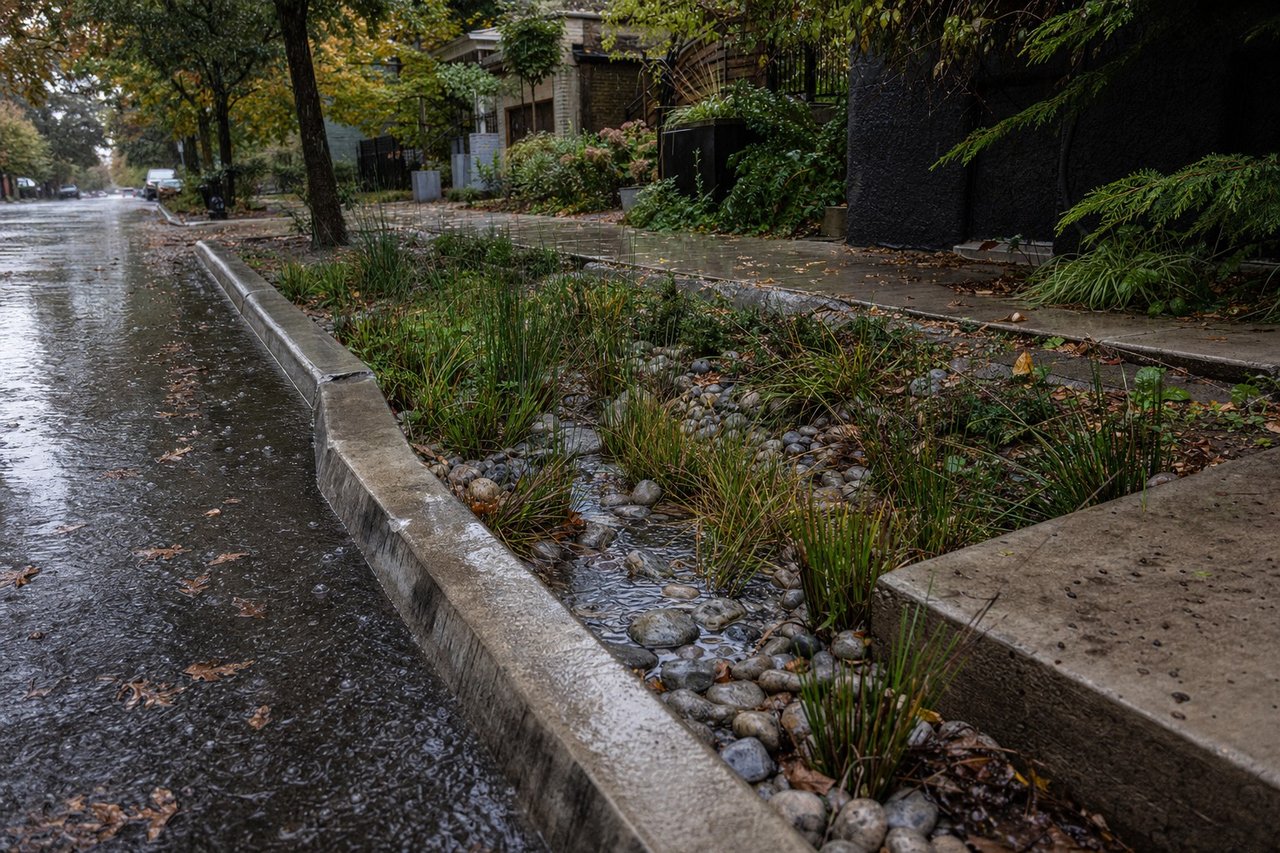
A bioretention cell is a shallow, planted depression engineered with layered soil media, usually sand or an engineered soil mix over a gravel base, sometimes with a perforated underdrain pipe at the bottom. Runoff flows in from an adjacent hard surface, pools briefly, and filters down through the soil layers, which strip out sediment and some pollutants before the water either infiltrates into the ground or exits slowly through the underdrain.
They show up in predictable places: parking lot edges and islands, street medians, the strip between a sidewalk and a curb, and residential yards where the smaller, less formally engineered version is usually just called a rain garden. Site selection matters more than it looks. A bioretention cell placed downhill of the area it’s meant to serve, so gravity does the work of getting runoff into it, performs far better than one bolted on as an afterthought.
The plants aren’t decorative. Deep-rooted, flood-tolerant species keep the soil structure open over years of wetting and drying, which is what keeps the cell infiltrating water instead of just holding a puddle.
Bioswales: Channels That Treat Water on the Move
A bioswale looks similar to a drainage ditch at a glance, but it does a different job. It’s a shallow, vegetated channel with a gentle slope, designed to convey stormwater from one point to another while treating it along the way. Check dams, engineered soil, and dense planting slow the flow, encourage settling, and filter out sediment and pollutants as the water travels the length of the channel.
Bioswales are most common along roadsides and highway medians, where a continuous linear space is available and a conventional curb-and-gutter system would otherwise route all that runoff straight to a storm drain. Because they’re built to convey as well as absorb, they can handle a larger catchment area than a stand-alone bioretention cell of similar size, which is part of why transportation departments favor them for corridor-scale projects.
Permeable Pavement: Letting the Ground Do Its Job
Permeable pavement replaces the usual assumption, that pavement is impervious by definition, with a surface engineered to let water through it. Porous asphalt and pervious concrete use a mix design with fewer fine particles, leaving interconnected voids throughout the material. Permeable interlocking pavers achieve the same effect differently, with wide joints between solid units filled with small aggregate. Either way, rain passes through the surface into a stone storage layer underneath, then infiltrates into the native soil or drains out at a controlled rate through a perforated pipe.
The upside is real: a parking lot or low-traffic street can manage a meaningful share of its own runoff without needing a separate bioretention cell nearby. It also tends to show up in specific settings rather than everywhere at once: sidewalks, plazas, alleys, parking lanes, and residential streets with light traffic, since heavy truck routes put more structural stress on the material than the porous mix can always handle over time.
The trade-off is just as real, and it’s the one thing every maintenance manual for permeable pavement leads with. Sediment and fine debris settle into the surface voids over time and can seal them shut, something a conventional impervious surface never has to think about. Cities that install it commit to regular vacuum-sweeping, typically once or twice a year depending on surrounding land use, to keep the pores open. Skip that maintenance for a few years and the pavement functions as ordinary, impervious pavement, minus the benefit it was installed for.
Green Roofs as a Stormwater Tool
Green roofs get most of their attention for reducing the urban heat island effect, a benefit covered elsewhere on this site. Their stormwater role is separate and worth treating on its own terms. A vegetated roof’s growing medium is a lightweight engineered soil, typically a few inches to a foot deep depending on the system. It absorbs a portion of incoming rainfall and releases the remainder gradually through evapotranspiration and slow drainage, instead of shedding nearly all of it at once the way a bare membrane roof does.
For dense urban blocks where there’s no ground-level space for a rain garden or bioswale, a green roof retrofit can be close to the only on-site option available. Retrofitting an existing building is a structural question first: the roof deck has to be checked for the added load of saturated soil, and waterproofing detailing has to be verified before anything gets planted. New construction has an easier time of it, since the structure can be designed around the load from the outset.
The industry splits green roofs into two rough categories. Extensive systems use a shallow growing medium, often four inches or less, planted with hardy, low-maintenance groundcover like sedum, and add relatively little weight to the structure below. Intensive systems go deeper, support a wider range of plants, sometimes including small trees, and hold more water per square foot, but they also add more load and typically need irrigation and more regular upkeep. Which one a building can support comes down to what the existing roof structure was built to carry.
Philadelphia, Portland, and Cities Building at Scale
Philadelphia’s Green City, Clean Waters program is one of the most thoroughly documented examples of green stormwater infrastructure deployed citywide. Adopted in 2011 under an agreement with the US Environmental Protection Agency, the 25-year plan committed the city to managing a set volume of stormwater runoff through green systems distributed across neighborhoods: rain gardens, bioswales, permeable pavement, and tree trenches. The alternative on the table was a single large underground storage tunnel to hold combined sewer overflow until it could be treated. The city’s own reporting has tracked thousands of individual green stormwater infrastructure sites built under the program in the years since.
Portland, Oregon has run its green-streets program since the mid-2000s, retrofitting curb extensions, stormwater planters, and bioswales into existing residential and commercial streets rather than waiting for full street reconstruction. The Tabor to the River project, one of the program’s better-known efforts, combined dozens of these small-scale installations with sewer separation work in a single southeast Portland watershed. Both programs share a structural feature worth noting: they were driven, at least in large part, by Clean Water Act obligations around combined sewer overflow, not by flood-control mandates specifically. Water quality and flood reduction turned out to point toward the same set of tools.
What Green Infrastructure Costs, and What It Doesn’t Save You From
The financial case for green stormwater infrastructure usually rests on a comparison: building enough small, distributed systems across a city, spread over years, against building one large piece of grey infrastructure sized to hold the same volume. Philadelphia’s own projections were part of why the city chose the green route over a deep storage tunnel. Land acquisition, soil conditions, and the density of the built environment all swing that comparison in either direction, so the math has to be run project by project rather than assumed.
What the upfront savings don’t include is the maintenance line. A buried pipe is largely a fire-and-forget asset once it’s built; it mostly needs to stay clear of blockages. A rain garden needs weeding and occasional replanting. A bioswale needs its inlets kept free of debris and its soil checked for compaction. Permeable pavement needs that vacuum-sweeping schedule, without exception, or it stops working within a few years. None of this is expensive on its own, but it’s a recurring cost with a different shape than a pipe’s, and it requires a maintenance crew and a budget line that some public-works departments haven’t fully built out yet, even where the infrastructure itself has already gone in the ground.
Some cities cover that gap with a stormwater utility fee, a line item billed to property owners based on how much impervious surface sits on their parcel, rather than folding the cost into general tax revenue. Others still pay for green infrastructure construction out of a capital budget and then discover, a few maintenance cycles later, that nobody assigned an operating budget to keep it functioning.
Frequently Asked Questions
What is green stormwater infrastructure?
+
Green stormwater infrastructure is a set of engineered but plant-based systems, including rain gardens, bioswales, permeable pavement, and green roofs, that capture rainwater close to where it falls and let it soak into the ground or evaporate, rather than routing it into pipes. It works alongside, not instead of, traditional pipe-and-drain systems in most cities.
What's the difference between a bioretention cell and a rain garden?
+
In practice, very little. Both are shallow, planted depressions that collect and filter runoff. Engineers tend to use bioretention cell for a designed system with layered soil media and often an underdrain, built to a specific stormwater-management standard, while rain garden usually describes a smaller, homeowner-scale version with similar function but less formal design.
What is a bioswale, and how is it different from a drainage ditch?
+
A bioswale is a shallow, vegetated, gently sloped channel that both moves stormwater and treats it as it travels, using plant roots and soil to filter out sediment and pollutants along the way. A plain drainage ditch just conveys water; it doesn't clean it. The vegetation and engineered soil layer are what turn a ditch into a bioswale.
How does permeable pavement work?
+
Permeable pavement looks like ordinary asphalt, concrete, or interlocking pavers, but it's manufactured with connected voids, or laid with wide joints filled with gravel, so rainwater passes straight through the surface into a stone reservoir underneath instead of running off. From there it filters slowly into the soil or drains to an outlet at a controlled rate.
What's the biggest drawback of permeable pavement?
+
Clogging. Sediment, leaf litter, and fine grit settle into the surface pores over time and can seal them shut, which conventional pavement never has to worry about. Cities that use permeable pavement generally commit to a regular vacuum-sweeping schedule, often once or twice a year, to keep the surface infiltrating at anywhere near its original rate.
How much maintenance does green infrastructure need compared to pipes and drains?
+
More, and of a different kind. A buried pipe mostly just needs to stay unblocked. A bioswale or rain garden needs its plants weeded, mulched, and occasionally replaced, its inlets kept clear of debris, and its soil checked for compaction. None of that is expensive individually, but it does require a maintenance crew and budget line that a lot of public-works departments aren't set up to fund long-term.
Do green roofs count as stormwater infrastructure?
+
Yes, alongside their better-known role in reducing urban heat. A vegetated roof's growing medium absorbs a portion of the rain that falls on it and releases the rest slowly, delaying and reducing the peak flow that reaches street-level drains. On a dense block where there's no room for a rain garden at ground level, a green roof can be the only real option for managing runoff on-site.
Is green infrastructure cheaper than traditional grey infrastructure?
+
Often, per gallon of stormwater managed, though it depends heavily on land costs and the specific project. Philadelphia adopted its Green City, Clean Waters plan in 2011 largely because building enough green infrastructure across the city was projected to cost less over 25 years than constructing a single giant deep-tunnel storage system to hold the same volume of combined sewer overflow.
Which cities have implemented green stormwater infrastructure at scale?
+
Philadelphia's Green City, Clean Waters program, launched under a 2011 agreement with the EPA, is one of the most documented examples in the US, using thousands of rain gardens, bioswales, and permeable surfaces to reduce combined sewer overflows. Portland, Oregon has run a parallel green-streets program since the mid-2000s, retrofitting curb extensions and planted stormwater facilities into existing streets block by block.
Can green infrastructure completely replace pipes and storm drains?
+
No. Even the most aggressive programs treat it as a supplement that reduces how much water reaches the pipe network and how fast, not a replacement for it. During the largest storms, when soil and plants are already saturated, the underlying grey system still carries the overflow.
How long does a bioswale or rain garden last before it needs to be rebuilt?
+
A well-maintained one can function for decades, since the core structure is soil, stone, and plants rather than mechanical parts that wear out. What usually forces a rebuild is neglect: years of unmanaged sediment buildup or dead, unreplaced vegetation that lets the system stop infiltrating altogether.
Does green infrastructure help with anything besides flooding?
+
Yes. The same plants and soil that slow runoff also filter out oil, metals, and other pollutants before they reach a river or storm sewer, which is a large part of why many programs were adopted under water-quality rules rather than flood-control ones. Shade and evapotranspiration from the vegetation also lower surrounding air temperature, though that's typically covered separately from a project's stormwater case.