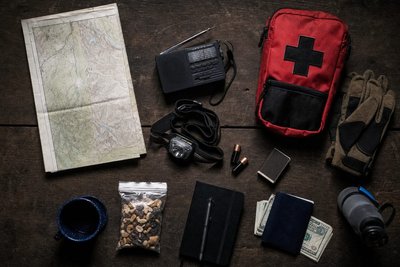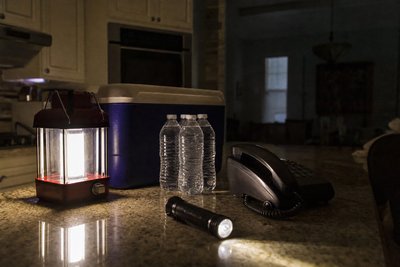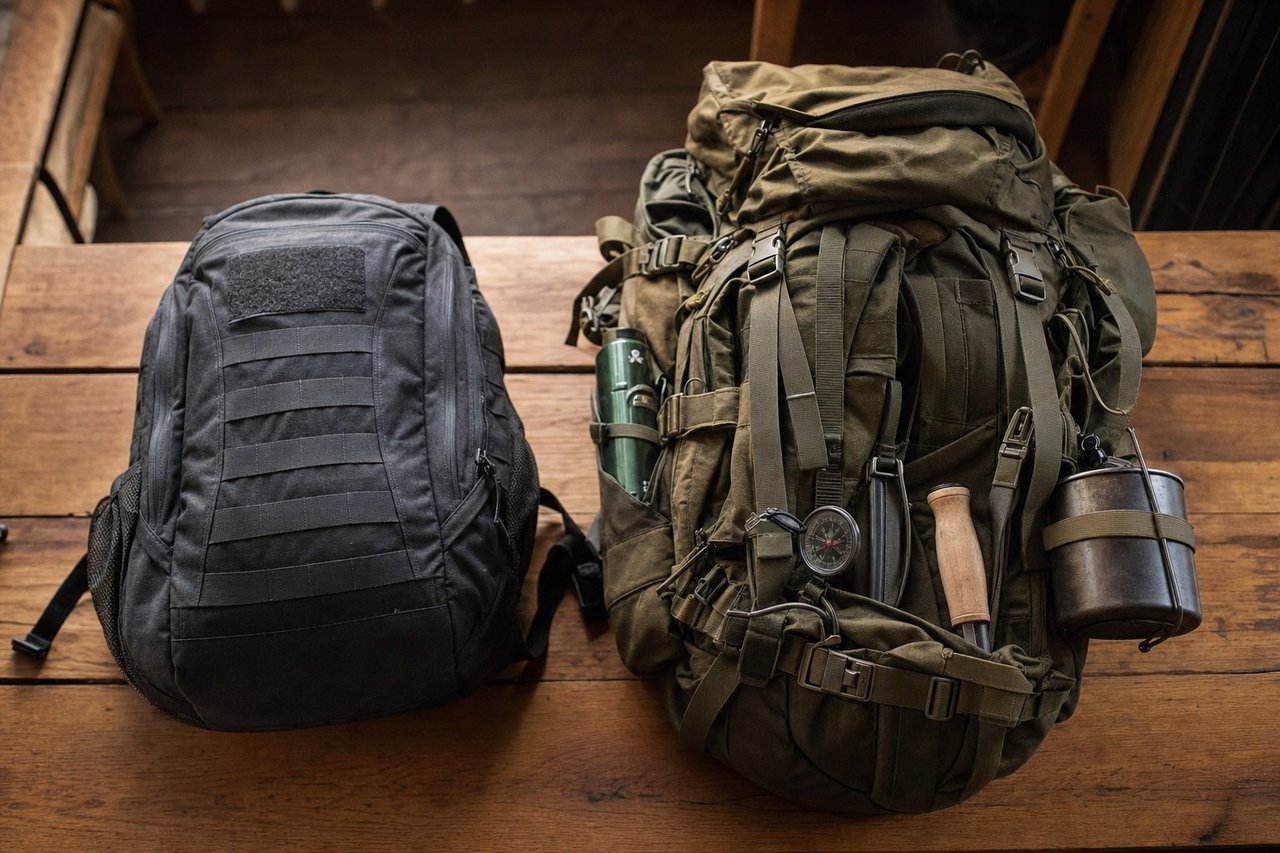
Type “survival kit” into a search bar and you’ll get results for two fairly different products: a nylon pouch with a fire starter and a compass, and a 72-hour backpack meant to get a family to a shelter. People use the term loosely enough that it’s worth stopping to ask which one you’re actually shopping for, because the two kits solve different problems.
An emergency kit, sometimes labeled a go-bag or a 72-hour kit, is built for a short-notice move to somewhere that already has services running: a shelter, a relative’s house, a hotel room. A survival kit is built on a harder assumption. It doesn’t expect help to show up soon, so it carries what’s needed for real self-sufficiency, whether that’s a wilderness situation, an extended isolation event, or a stretch of days with no outside support at all.
The confusion is understandable. Both are packed in advance. Both get grabbed in a hurry. But pack the wrong one for your actual situation and you end up with either a bag full of tools you’ll never need, or a bag missing the one thing that would have mattered.
A retailer selling “survival kits” online often means the go-bag version, because that’s what most buyers are actually searching for when they type the phrase into a search bar. A genuine wilderness survival kit, the kind built around fire, navigation, and indefinite self-sufficiency, is a smaller market, and it’s usually sold or discussed under more specific labels: bushcraft kit, backcountry kit, ten-essentials kit. Knowing that up front saves a fair amount of wasted browsing.
The assumption each kit is built on
This is the real dividing line, and almost everything else follows from it. A go-bag is designed around the question “how do I get through the next 72 hours until I reach somewhere with power, water, and other people?” A survival kit is designed around a different question entirely: “how do I stay alive and functional if nobody arrives at all?”
That single difference in assumption shapes every item inside. A go-bag doesn’t need a compass, because you’re heading to a known address. A survival kit doesn’t prioritize a phone charger, because in the scenario it’s built for, there may be no signal to charge for. Neither kit is more “serious” than the other. They’re built for different failure modes, and matching the kit to the actual risk is the whole exercise.
What belongs in a survival kit that a go-bag skips
A genuine survival kit carries tools aimed at open-ended self-sufficiency, not a three-day bridge to help.
- Fire-starting tools. A ferro rod or waterproof matches, plus tinder, for warmth, water sterilization by boiling, and signaling. A go-bag rarely needs this because it isn’t built around cooking or heating in the field.
- Serious water purification. Filters or purification tablets rated for untreated lake, stream, or snowmelt water, not the lighter contamination assumptions built into most go-bag purification gear.
- Navigation tools. A compass and a topographic map. If you’re relying on a phone for navigation, you’re already assuming infrastructure a survival kit doesn’t assume exists.
- Signaling devices. A mirror, a loud whistle, sometimes a personal locator beacon, for a scenario where you can’t simply walk to a known destination and need to be found instead.
- Sturdier shelter materials. A tarp, bivy sack, or emergency bivy bag built to hold up over multiple nights, not the thin emergency blanket that’s adequate for a single uncomfortable night in a car.
None of this is exotic gear. It’s just gear aimed at a longer, less certain timeline than a go-bag ever plans for. A lot of it also assumes practice. A ferro rod is useless in the hands of someone who has never tried to strike one in the rain, and a compass is only as good as your ability to take a bearing off a map. That’s a meaningful difference from a go-bag, where most of the contents work the moment you open the package.
What a go-bag prioritizes that a survival kit doesn’t
Flip the comparison around and the pattern holds. A go-bag leans hard into re-entry items: things that matter once you reach a shelter, a hotel, or a relative’s home and need to function in ordinary society again quickly. Copies of ID and insurance documents. Cash, because card networks and ATMs can go down with the power grid. A phone charger, since a working phone is genuinely useful once you’re somewhere with signal and power.
A survival kit doesn’t skip these out of oversight. It skips them because they don’t solve the problem it’s built for. A driver’s license copy is worth nothing in a scenario where the nearest DMV, bank, or hotel front desk is days away and unreachable. That’s not a flaw in the survival kit; it’s a different set of assumptions doing different work.
Who actually needs which one
Here’s where the theory has to meet an honest look at your own risk. Most households living somewhere with wildfire, flood, storm, or grid-failure exposure are far better served by a solid emergency kit than a wilderness survival kit. The realistic bad day for a suburban household is an evacuation order, a multi-day power outage, or a flooded basement, not being stranded in backcountry with no route out.
A survival kit earns its place under a narrower set of circumstances: living somewhere a single washed-out road cuts off outside access for a week or more, regular backcountry travel, hunting or extended off-grid recreation, or a genuine risk that rescue services could be delayed well past the standard 72-hour window most go-bags are built around.
| Emergency kit (go-bag) | Survival kit | |
|---|---|---|
| Core assumption | Help arrives within days | No guaranteed help arriving |
| Typical scenario | Evacuation to a shelter or relative’s home | Wilderness, remote isolation, extended cutoff |
| Includes | Documents, cash, charger, 72-hour food/water | Fire-starting, navigation, sturdier shelter, heavy-duty water purification |
| Who it fits | Most urban and suburban households | Remote/rural residents, backcountry travelers |
| Complexity | Buy-and-store | Skill-dependent; gear alone isn’t enough |
That table is a starting point, not a verdict. Plenty of households sit somewhere in between, and the honest answer for them is usually “mostly go-bag, with one or two survival-kit items layered in.”
Where the two genuinely overlap
Strip away the divergent gear and there’s a shared core: water, a light source, and a first-aid kit show up in both, in some form. Every version of “something has gone wrong and I need to get through the next stretch of time” starts there. The two kits just disagree on scale and duration. A go-bag might carry three liters of water and a basic filter. A survival kit carries the tools to keep finding and purifying water indefinitely, because it isn’t assuming a resupply point three days out.
That overlap is worth building once, not twice. There’s no reason to duplicate a first-aid kit across two separate bags if one bag is your daily-carry-adjacent go-bag and the other lives in a truck for backcountry trips. Build the shared core once, then decide separately whether the survival-specific layer, fire, navigation, heavier-duty water gear, is worth adding on top for your actual situation.
A household that hunts every fall, tows a boat most summers, or lives at the end of a long gravel road with one bridge between them and town has a real case for both kits living in the house at once, built on the shared core and diverging from there. A household in a subdivision fifteen minutes from three different hospitals almost never does.
A quick way to decide
If you’re not sure which kit your household actually needs, three questions get you most of the way there:
- If disaster hit tonight, where would you realistically end up within 72 hours? A shelter, a relative’s house, a hotel: that’s go-bag territory. Nowhere, because you’re genuinely remote or off-grid: that’s survival-kit territory.
- Does your region’s hazard profile involve isolation, or displacement? Wildfire, flood, and storm evacuations are displacement events. Getting stranded on a mountain trail or cut off by a washed-out access road is an isolation event.
- Do you already own, or know how to use, fire-starting and navigation gear? If the honest answer is no, and your risk is displacement rather than isolation, a survival kit is solving a problem you don’t have yet.
Ready.gov, FEMA’s public-facing preparedness site, and the American Red Cross both build their household guidance around the 72-hour emergency-kit model, because that’s the scenario the overwhelming majority of households actually face. Wilderness-survival kit guidance tends to come from a different corner entirely: outdoor-education groups like the National Outdoor Leadership School, whose audience is backcountry travelers, not people bracing for a hurricane a few miles from a highway.
Most people reading this need one well-built go-bag and maybe a compact fire kit tucked into a car console for the rare backcountry drive. The full wilderness setup, ferro rod, topo map, bivy sack, and all, is worth the money and the practice time for a much smaller group: the ones whose actual bad day involves nobody arriving at all.
Frequently Asked Questions
What's the actual difference between an emergency kit and a survival kit?
+
An emergency kit (often called a go-bag or 72-hour kit) assumes help is coming: a shelter, a relative's spare room, a hotel, somewhere with power and running water within a few days. A survival kit assumes the opposite. It's built on the premise that no one is arriving soon, so it carries the tools to make water safe, start a fire, navigate without a phone, and shelter in place indefinitely.
Do I need a survival kit if I already have a go-bag?
+
Most households in cities and suburbs don't, at least not a full one. If your climate risks are wildfire, flood, storm, or a multi-day power outage, and your evacuation plan ends at a shelter or a family member's house, a solid go-bag covers the realistic scenario. A survival kit earns its place if you're remote, rural, or regularly out of cell range.
What does a survival kit contain that a standard go-bag doesn't?
+
Fire-starting tools (ferro rod, waterproof matches, tinder), a compass and topographic map, a signaling mirror or whistle audible over long distances, water-purification gear rated for untreated backcountry sources rather than municipal runoff, and shelter materials like a tarp or bivy sack meant to hold up for days, not one uncomfortable night.
What does a go-bag prioritize that a survival kit skips?
+
Documents, mostly. Copies of ID, insurance papers, a phone charger, cash in small bills, a list of medications. A survival kit doesn't optimize for re-entering normal society quickly, because it isn't built around the assumption that normal society is a few days away. Those items simply don't solve the problem a survival kit is designed for.
Where do the two kits overlap?
+
Water, light, and first aid, in some form, belong in both. Every version of "something goes wrong and I need to get through the next stretch of time" starts with those three. The kits diverge on how much of each you carry and what you assume happens after: a go-bag assumes days, a survival kit assumes it could be longer, with no guaranteed resupply.
Is a survival kit overkill for someone who just wants to be prepared for a storm?
+
For most storm scenarios, yes. A storm-prep household is planning around a power outage and a possible short evacuation, not weeks of isolation in the woods. The fire-starting and navigation gear in a true survival kit solves a problem storm prep doesn't usually have. A go-bag plus a stocked pantry covers that situation better than a wilderness kit would.
Who genuinely needs a survival kit?
+
People whose actual risk includes extended isolation: backcountry hikers, hunters, anyone living somewhere a single washed-out road cuts off outside help for a week or more, and residents of areas where wildfire or flood can plausibly delay rescue services well past the 72-hour window a standard go-bag is built around.
Is a survival kit more expensive to put together than an emergency kit?
+
Usually, yes, and it's also more skill-dependent. A go-bag is mostly buy-and-forget items. A survival kit's most useful contents, a ferro rod, a compass, water-purification gear, are only worth carrying if you know how to use them under stress, which means the real cost includes training time, not just the gear itself.
How does a go-bag relate to a survival kit if I want to build both?
+
Think of the go-bag as the base layer and the survival kit as an optional module you add if your actual risk profile calls for it. Don't duplicate the water, light, and first-aid basics twice; build one core kit, then layer survival-specific tools like fire-starting and navigation gear on top only if isolation risk is real for your situation.
Can one kit serve both purposes if I only want to build one?
+
A well-built go-bag with a compact fire-starting kit and a basic compass added covers a surprising amount of middle ground, and that's a reasonable compromise for households that face some backcountry or remote-travel risk but don't want two separate kits. It won't fully replace a dedicated survival kit for genuine wilderness use, but it closes most of the gap.
Do organizations like FEMA or the Red Cross recommend survival kits for households?
+
Ready.gov, FEMA's public preparedness site, and the American Red Cross both focus their household guidance on the 72-hour emergency-kit model, not wilderness survival gear, because that's the scenario most households actually face. Wilderness-survival kit guidance tends to come from outdoor-education organizations like the National Outdoor Leadership School (NOLS), aimed at backcountry travelers rather than home preparedness.